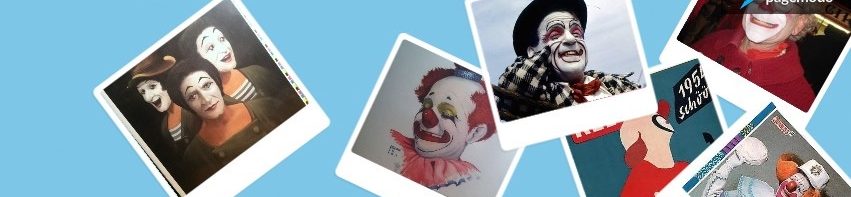

Character of the white face clown
The white face clown, a.k.a. the classic clown or the whiteface clown, is the clown most people first think of when they hear the word “clown.” Associated with the circus, the whiteface clown is the most intelligent of the clowns, and is typically at the top of the pecking order. The Whiteface clown will typically be the ringleader, who will order around the other clowns, and who has his “clownishness” revealed either by his own ineptness or by that of his underling.

The whiteface clown, however, shouldn’t need to feel constrained by this; as with any clown, he can be any personality (slow, fast, quick-witted, dull, quickly angered, coming to a slow burn, etc.) that would be funny. This is the oldest of the clown types, with many excellent examples, including Francesco Caroli, Frosty Little, Bob Bell as Bozo the clown, Bobby Kay, Felix Adler, Blinko, Duane Thorpe as Uncle Soapy, George Fox and Joseph Grimaldi and many others.
Makeup of the white face clown

There are two major classes of the white face clown, and thus two styles of make-up. The first is the standard, or classic, whiteface clown. This consists of a white base, with make-up to accent the eyes and mouth. This is the clown type many people associate with the circus. Francesco Caroli and Glenn “Frosty” Little is a good example of this type. A zanier, less-intelligent style of clown is the comedy, or grotesque, whiteface. Here the makeup is more exaggerated, to emphasize the more outrageous nature of this clown.

Bozo the clown is a good example of this type. Both styles may be with a bald cap, with hair, or with partial hair. Note that the more outrageous hairstyle typically belong to the comedy whiteface. With either style, the object is to enhance the natural features of the face, never to hide them. The clown takes his or her natural facial features and exaggerates; also, don’t forget that many in your audience (in a walkaround, for example) may be further away – this is why the features are ‘outlined’ – study the eyes and mouths of Bob Bell‘s Bozo and Frosty Little for examples. For more detail on make-up, I recommend Strutter’s Complete Guide to Clown Make-up.
History of the white face clown


The whiteface is the oldest style of clown, dating back to Greek theater. Contrary to popular belief, the clown does NOT wear makeup to hide or disguise his figures, but rather to reveal them. In Greek theater, lighting was poor (compared to modern day theater). So a white background with black markings served well to illuminate the actor’s features. A well-known ancestor of the whiteface is the court jester of the middle ages. However, authentic court jesters often performed with little or no make-up at all. The comedy troupe of the Commedia del arté popularized several clown characters, including Pierrot, Columbine, Harlequin, and Clown. Yes, that was the character’s name! All of whom were originally masked characters, several of whom eventually evolved into whiteface clowns.
A major subtype of the whiteface has also evolved. Unlike the court jester or classic whiteface, who can be considered quite intelligent (given a clown’s unique perspective ;), the “Comedy” or “Grotesque Whiteface” is more buffoonish, with more outlandish and mismatching clothing, and a more exaggerated style. In the comedic partnership of Abbot & Costello, Bud Abbot would have been a classic whiteface; Lou Costello either a comedy whiteface, or an Auguste.
Costume of the white face clown
Traditionally, the whiteface clown would wear a one-piece outfit, decorated either snazzily or outlandishly, depending on the clown’s character. Today, that is no longer the case. The whiteface clown can wear virtually anything that fits in with his character — for examples, I suggest that you look at some of the costuming ideas at Costumes by Betty (run by Betty Cash, professional clown & instructor at the UW-LaCrosse Clown Camp).